
-
U.S., Egypt look to post-Mubarak era
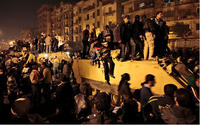
The days of Hosni Mubarak in office appear numbered, and there are behind-the-scenes discussions among U.S., Egyptian, and Saudi diplomats about a “smooth transition”; it is not yet clear whether the efforts to ease Mubarak out are meant to allow the military regime which came to power in 1952 to remain in power, headed by more acceptable leaders than Mubarak, or whether these efforts are aimed at a more thorough revamping of the Egyptian political system; the main goal is to prevent a repetition of the Iran 1979 scenario: an authoritarian regime replaced by a centrist, secular — but weak and devoid of support — government, only for that government to be swept from power by the Ayatollahs within months
-
-
China's increasing military might causes concern in Asia, West
China’s recent test flight of its first stealth fighter comes as part of a larger military buildup that is concerning its Asian neighbors and the West; the Chinese test of their first fifth generation stealth fighter is years ahead of U.S. intelligence predictions; China is also moving ahead with the construction of its first aircraft carrier as well as other capabilities like a “carrier killing” ballistic missile; in response to China’s stealth fighter test, Taiwan test-fired nineteen missiles; nearly a third of the missiles failed; it is unclear what China’s intentions are though leaders claim these weapons are for self-defense
-
-
South Korean navy recaptures pirated tanker
South Korean special forces team boards a pirate-held tanker in the Arabian Sea; pirates were killed, injured or captured; 21 sailors rescued after being held since last Saturday; three rescuers sustain minor injuries
-
-
UN indicts Hezbollah chiefs in Hariri assassination
Prosecutor for international tribunal investigating assassination of former Prime Minister Hariri files indictment with pre-trial judge; Nasrallah threatens to “cut off the hands” of anyone attempting arrest of Hezbollah members; turmoil grows following last week’s collapse of government
-
-
Invisible tanks to be deployed within five years
British military scientists plan to develop an army of “invisible” tanks ready for use on the battlefield within five years. Armored vehicles will use a new technology known as “e-camouflage” which deploys a form electronic ink to render a vehicle invisible; highly sophisticated electronic sensors attached to the tank’s hull will project images of the surrounding environment back onto the outside of the vehicle enabling it to merge into the landscape and evade attack
-
-
Bombs in flight -- Friday's false alarm not false
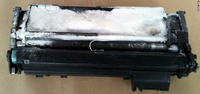
Friday’s emergency activity concerned with finding explosive devices initially reported as a false alarm — early reports indicated no explosives were found; this proved to be wrong in subsequent reports, live devices containing PETN were found in the U.K. and Dubai; in the instance of the Dubai device, the bomb package had been flown on two passenger flights; U.S. intelligence analysis identify bombmaker; Yemeni authorities arrest and later release female student on suspicion of complicity
-
-
False alarm at U.S., U.K. airports
Several United Parcel Service flights arriving at U.S and U.K. were moved to areas isolated from other aircraft, and searched for explosive devices; to this point no explosives have been found
-
-
Northrop shows big-gun armed robot
Northrop took its Carry-all Mechanized Equipment Landrover, or CaMEL — a 60-inch-tall treaded vehicle capable of carrying an impressive 1,200 pounds of stuff — and put a massive .50 caliber M2 machine gun on it; Israel has already ordered 60 of them, and the U.S. Army is considering (after an unpleasant experience with an earlier armed robot in Iraq two years ago)
-
-
Pakistan: Several dozens of Europeans in terror training in Pakistan
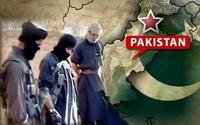
Pakistan, Western intelligence agencies say several dozens Muslim militants with European citizenship are believed to be hiding out in the lawless tribal area of northwestern Pakistan, training for missions that could include terror attacks in European capitals; among the militants are at least twenty British and twenty German citizens; the groups voice-printing software enables British intelligence to identify and track specific individuals believed connected to terror plots; mobile phone communications have been tracked from the border area to points in Britain, particularly England’s Midlands, where there is a heavy Pakistani immigrant population
-
-
World unprepared for "convergent crisis"
Specialists in disaster response say that nations are almost completely unprepared for the likely emergence of so-called convergent crises with the potential to plunge markets and regions into prolonged turmoil; in these multi-faceted disasters, strains like a shrinking Arctic ice cap, theft of nuclear materials, oil or water shortages, or cyber crime would worsen tensions among nations over traditional issues such as trade, territory, and resources
-
-
Quo Vadis Turkey?
The Sunday, 12 September referendum in which 58 percent of the voters approved reforms in the Turkish constitution — reforms which would limit to ability of the courts and the military to protect Turkey’s secularist tradition — may lead to changes in Turkey’s domestic and foreign policies, but it is not yet clear how far Erdogan’s Islamist government will go in pushing these changes, and what countervailing forces, domestic and foreign, the government will encounter
-
-
U.K. citizens to be spied on by foreign police
The U.K. Home Office today signed up to the European Investigation Order (EIO) which, when it is approved by the European Parliament, would allow any police force in Europe to spy on and pursue Britons even for the minor offenses; the power allows prosecutors from any EU country to demand details such as DNA or even bank and phone records on anyone they suspect of a crime as minor as leaving a restaurant without paying the bill
-
-
Leaked U.S. documents: Pakistan collaborates with the Taliban to kill Americans
Leaked U.S. military documents offer detailed and disturbing accounts of the degree and scope of the cooperation between Pakistan’s intelligence agency and anti-American forces in Afghanistan; this cooperation comes from an agency of a country that receives more than $1 billion a year in aid from the United States; ISI, the Pakistani secret service, recruits insurgents, trains them, supplies them, helps them choose targets, and provides them with the weapons to carry out attacks; the cooperation has resulted in the death of many American soldiers and, more broadly, is aimed to undermine U.S. strategy and goals in Afghanistan
-
-
Second drug submersible seized
Colombia’s drug cartels frequently use semi-submersible vessels to smuggle large amounts of cocaine past American and Colombian patrol boats to Central America en route to the United States; law enforcement discovers and seizes second submersible in as many weeks: the first was seized in Ecuador, the second in Guatemala
-
-
Ireland to block EU-Israel data-sharing agreement
The EU and Israel planned on launching a data sharing agreement aimed to enable law enforcement better to identify and track terrorists and criminals; Ireland, still smarting from what it says was Israel intelligence’s misuse of Irish passports in the assassination of a Hamas leader in Dubai earlier this year, blocks the agreement
-

The long view
No Nation Is an Island: The Dangers of Modern U.S. Isolationism
The resurgence of isolationist sentiment in American politics is understandable but misguided. While the desire to refocus on domestic renewal is justified, retreating from the world will not bring the security, prosperity, or sovereignty that its proponents promise. On the contrary, it invites instability, diminishes U.S. influence, and erodes the democratic order the U.S. helped forge.
Fragmented by Design: USAID’s Dismantling and the Future of American Foreign Aid
The Trump administration launched an aggressive restructuring of U.S. foreign aid, effectively dismantling the United States Agency for International Development (USAID). The humanitarian and geopolitical fallout of the demise of USAID includes shuttered clinics, destroyed food aid, and China’s growing influence in the global south. This new era of American soft power will determine how, and whether, the U.S. continues to lead in global development.
Water Wars: A Historic Agreement Between Mexico and US Is Ramping Up Border Tension
As climate change drives rising temperatures and changes in rainfall, Mexico and the US are in the middle of a conflict over water, putting an additional strain on their relationship. Partly due to constant droughts, Mexico has struggled to maintain its water deliveries for much of the last 25 years, deliveries to which it is obligated by a 1944 water-sharing agreement between the two countries.
How Disastrous Was the Trump-Putin Meeting?
In Alaska, Trump got played by Putin. Therefore, Steven Pifer writes, the European leaders and Zelensky have to “diplomatically offer suggestions to walk Trump back from a position that he does not appear to understand would be bad for Ukraine, bad for Europe, and bad for American interests. And they have to do so without setting off an explosion that could disrupt U.S.-Ukrainian and U.S.-European relations—all to the delight of Putin and the Kremlin.”