
-
German law would require measles vaccination to attend schools, kindergartens, daycare
German children will have to prove they have had a measles vaccination before they would be allowed to attend kindergarten or go to school. A new draft law imposes steep fines on parents who refuse to immunize their children.
-
-
UN agency launches new vehicle to fund antimicrobial resistance
The Food and Agriculture Organization (FAO) of the United Nations (UN) has launched a new funding vehicle meant to accelerate the response to rising global rates of antimicrobial resistance (AMR). The AMR Multi-Partner Trust Fund was developed through the joint efforts of the Tripartite—the FAO and sister UN agencies the World Organization for Animal Health, and the World Health Organization.
-
-
Religion and vaccine refusal are linked. We have to talk about it.
As measles cases have surged across the US and Europe this year, there’s been a lot of talk about what’s causing the outbreaks. Among the most discussed issues: mistrust of the medical establishment, populist politics fueling vaccine doubt, and the spread of misinformation on social media. A comprehensive survey found that people in higher-income countries were among the least confident in vaccine safety — particularly in North America and Europe. Meanwhile, vaccine trust was highest in countries where preventable diseases still spread, such as Bangladesh and Rwanda. So the further people are from outbreaks, and the more distant the memory of diseases like whooping cough and measles, the more likely they are to shun vaccines. Julia Belluz writes in Vox that the survey also uncovered something that unites some of the communities where outbreaks have been spreading lately, and it’s not as easy to talk about: religious belief.
-
-
A first: Salmonella resistant to antibiotics of last resort found in U.S.
Researchers have found a gene that gives Salmonella resistance to antibiotics of last resort in a sample taken from a human patient in the U.S. The find is the first evidence that the gene mcr-3.1 has made its way into the U.S. from Asia.
-
-
Russian trolls, bots spread false vaccine information on Twitter
A study found that Russian trolls and bots have been spreading false information about vaccination, in support of the anti-vaccination movement. The false information was generated by propaganda and disinformation specialists at the Kremlin-affiliated, St. Petersburg-based IRA. The Kremlin employed IRA to conduct a broad social media disinformation campaign to sow discord and deepen divisions in the United States, and help Donald Trump win the 2016 presidential election.
-
-
New estimates aim to define the true burden of superbug infections
Millions of Americans who experience complications from an antibiotic-resistant infection each year. These infections place a substantial clinical, emotional, and financial burden on patients, their families, and the US healthcare system. But just how many people in the United States are dying from antibiotic resistance? Many researchers and epidemiologists wrestle with that question.
-
-
A global wave of measles cases fed by conspiracies and misinformation has health officials worried
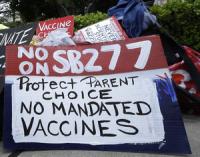
The number of people infected with measles keeps rising in the Washington State and neighboring Oregon. Rick Noack writes that “complacency over vaccinations has been accompanied by outright rejection of the scientific evidence on measles vaccines that has saved over 21 million lives since 2000, according to the WHO. Unsubstantiated conspiracy theories on supposedly negative side effects of vaccinations, either against measles or in a broader context, have gained momentum in some communities, in the United States and other countries.” He notes that deliberately spreading misinformation on vaccines to suggest that citizens are being lied to by their leaders has become a go-to recipe of some populist politicians. Thus, after years of railing against vaccines and even proposing a law against them in 2015, Italy’s Kremlin-supported Five Star Movement is now part of the country’s government.
-
-
Widespread, occasional use of antibiotics linked to resistance
The increasing prevalence of antibiotic resistance in the U.S. appears more closely linked to their occasional use by many people than to their repeated use among smaller numbers of people. A new study also found that antibiotic use varies across the nation, and that in areas where particular antibiotics are used more frequently, resistance to those antibiotics is higher.
-
-
The counties where the anti-vaccine movement thrives in the U.S.
As a pediatrician-scientist who develops new vaccines for neglected diseases, I followed the emergence of doubt over vaccine safety in the general public. Ultimately, in scientific circles, any debate ended when an overwhelming body of scientific evidence demonstrated there was no association between vaccines and autism. In Texas, however, the anti-vaccine movement is aggressive, well-organized and politically engaged. There are now at least 57,000 Texas schoolchildren being exempted from their vaccines for nonmedical reasons, about a 20-fold rise since 2003. I say “at least” because there is no data on the more than 300,000 homeschooled kids.
-
-
Vaccination myths must be debunked: Experts
An analysis of anti-vaccine witness statements presented during the Texas Legislature’s 2017 session revealed recurring misconceptions that need to be challenged, according to an experts. The experts say that there are five recurring misconceptions about vaccines: that they are ineffective; herd immunity is a myth; vaccines “shed” and cause the spread of disease; the impacts of vaccine-preventable diseases are minor; and vaccine-exempt children are not spreading disease. “Each of these myths is inaccurate and unscientific,” the experts say.
-
-
Rapidly identifying antibiotic-resistant “superbugs”
When you get sick, you want the right treatment fast. But certain infectious microbes are experts at evading the very anti-bacterial drugs designed to fight them. A simple and inexpensive new test developed by UC Berkeley researchers can diagnose patients with antibiotic-resistant strains of bacteria in a matter of minutes. The technique could help doctors prescribe the right antibiotics for each infection, and could help limit the spread of antibiotic-resistant “superbugs,” which kill as many as 700,000 people worldwide each year.
-
-
Sales of vet antibiotics in Europe decline
A report yesterday from the European Medicines Agency (EMA) shows a significant drop in overall sales of veterinary antibiotics across Europe. The data from the EMA’s eighth European Surveillance of Veterinary Antimicrobial Consumption (ESVAC) report show a 20.1 percent decline in sales of antibiotics for food-producing animals in 25 European Union (EU) countries from 2011 through 2016, with notable decreases in the sales of antibiotics that are critically important in human medicine.
-
-
Ramping up fight against antimicrobial resistance
The U.S. government is challenging world leaders, corporations, and non-governmental groups to step up their efforts against antimicrobial resistance (AMR). The AMR Challenge asks for at least one commitment in one of five areas: improving antibiotic use in humans and animals; reducing antibiotics and resistant bacteria in the environment; developing new antibiotics, vaccines, and diagnostics; enhancing data collection and sharing; and improving infection prevention and control.
-
-
Plugging an antibiotic pump
Each year in the U.S., at least 23,000 people die from infections caused by antibiotic resistant bacteria. Using computer modeling, researchers from Sandia National Laboratories and the University of Illinois at Urbana-Champaign are helping to develop the means to prevent some of those deaths.
-
-
Low antibiotic levels in the environment may spur drug resistance
A new study is providing new evidence that low concentrations of antibiotics in the environment could be contributing to the evolution of antibiotic resistance. The researchers report that even when bacterial communities in wastewater are exposed to small amounts of the antibiotic cefotaxime, selection pressure for clinically important antibiotic-resistant genes occurs. Moreover, they also found that the selection pressure for resistance may be just as strong as when exposed to high concentrations of the drug.
-

- All
- Regional
- Water
- Biometrics
- Borders/Immig
- Business
- Cybersecurity
- Detection
- Disasters
- Government
- Infrastructure
- International
- Public health
- Public Safety
- Communication interoperabillity
- Emergency services
- Emergency medical services
- Fire
- First response
- IEDs
- Law Enforcement
- Law Enforcement Technology
- Military technology
- Nonlethal weapons
- Nuclear weapons
- Personal protection equipment
- Police
- Notification /alert systems
- Situational awareness
- Weapons systems
- Sci-Tech
- Sector Reports
- Surveillance
- Transportation
Advertising & Marketing: advertise@newswirepubs.com
Editorial: editor@newswirepubs.com
General: info@newswirepubs.com
2010-2011 © News Wire Publications, LLC News Wire Publications, LLC
220 Old Country Road | Suite 200 | Mineola | New York | 11501
Permissions and Policies
Editorial: editor@newswirepubs.com
General: info@newswirepubs.com
2010-2011 © News Wire Publications, LLC News Wire Publications, LLC
220 Old Country Road | Suite 200 | Mineola | New York | 11501
Permissions and Policies